ZX Spectrum guide
ZX Spectrum History: The Computer That Started British Gaming
How a small, cheap computer with rubber keys became the machine a generation of Britons learned to play and program on, and why it's still loved today.
In short
- Sinclair Research launched the ZX Spectrum in April 1982, at £125 for 16K and £175 for 48K.
- It sold around five million machines and became the best-selling British computer of its era.
- Thousands of games were written for it, many by teenagers, helping to found the UK games industry.
- Amstrad bought Sinclair's computer business in 1986 and made the +2 and +3; production ended in 1992.
- New machines and new games are still being made today.
Before the Spectrum: the ZX80 and ZX81
Clive Sinclair's company had made calculators and pocket televisions before it turned to computers. The ZX80 of 1980 was sold for under £100, a price that put a computer within reach of ordinary families for the first time. The ZX81 followed in 1981, cheaper again and sold through high-street shops. Both were black and white, with a flat, touch-sensitive keyboard and just 1 KB of memory as standard.
They proved there was a huge market for a cheap home computer. The next machine needed colour, sound and more memory.
1982: the ZX Spectrum arrives
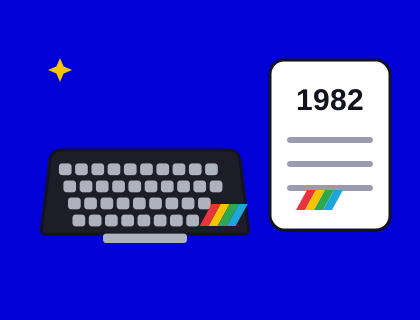
The ZX Spectrum was launched in April 1982. Its name came from its headline feature: colour. The hardware was designed by Richard Altwasser and the ROM software, including its version of BASIC, by Steve Vickers working with Nine Tiles. Rick Dickinson designed the compact black case with its rainbow stripe and grey rubber keys.
Two versions went on sale: 16K for £125 and 48K for £175. Demand quickly outran supply, and early buyers waited months. The machines were built under contract by Timex at its factory in Dundee.
The Spectrum was a clever compromise. To keep the price down it had a very simple sound system (a single "beeper"), a keyboard made from a rubber mat, and a colour system that set colours for each 8×8 block of pixels rather than each pixel. That last decision gave Spectrum games their look, explained in our guide to attribute clash.
The bedroom coders
Every Spectrum came with BASIC built in, and the manual taught you to program. Thousands of owners did exactly that. Some wrote games good enough to sell, and in the early 1980s a teenager with a cassette duplicator and a small advert in a magazine could become a publisher.
Games such as Manic Miner (1983), Jet Set Willy (1984) and Ultimate Play the Game's Knight Lore (1984) became famous, and companies such as Ocean, Imagine, Ultimate and later Codemasters grew from the Spectrum market. Budget labels sold games for a pound or two. Magazines including Sinclair User, Crash and Your Sinclair reviewed them, printed listings to type in and gave away demo tapes.
Many people now in the games industry, in Britain and across Europe, started out on the Spectrum.
New models: the Spectrum+ and the 128K
In 1984 Sinclair released the Spectrum+, the same computer in a bigger case with a harder-wearing keyboard and a reset button. The ZX Spectrum 128 came next, launched first in Spain in 1985 and in the UK early in 1986. It added more memory and, crucially, a proper three-channel sound chip, the AY-3-8912. Our guide to 48K vs 128K explains the difference it made.
Sinclair Research had also bet heavily on other products, including the QL business computer and the C5 electric vehicle, and by 1986 the company was in financial trouble.
1986 to 1992: the Amstrad years
In 1986 Amstrad, led by Alan Sugar, bought the rights to Sinclair's computers and the Sinclair name. Amstrad released the grey Spectrum +2 with a built-in cassette deck, then the +3 in 1987 with a built-in 3-inch disk drive, and later the black +2A. Our guide to every Spectrum model compares them.
By the end of the 1980s 16-bit machines like the Amiga and Atari ST, and then games consoles, were taking over. The Spectrum was discontinued in 1992, after about five million had been sold.
Clones and the Spectrum abroad
The Spectrum was also sold or copied around the world. Timex sold its own version in the USA, and Spain had a strong Spectrum scene. In the Soviet Union and Eastern Europe, enthusiasts and factories built their own compatible machines, such as the Pentagon and Scorpion, and kept making and using them well into the 1990s.
The Spectrum today
The Spectrum never really went away. Emulators kept the games alive on PCs from the late 1980s onwards, and volunteers have catalogued and preserved tens of thousands of titles. New games are released every year, written in assembly language or with modern tools; you can play seven of them in our arcade.
There's new hardware too. The ZX Spectrum Next, funded by Kickstarter, is an enhanced Spectrum in a case designed by Rick Dickinson. Retro Games Ltd's The Spectrum is a full-size remake that plugs into a modern TV.
Sir Clive Sinclair, knighted in 1983, died in 2021. His cheap, cheerful computer is still being played on four decades after its launch.
Questions and answers
When did the ZX Spectrum come out?
Sinclair Research launched the ZX Spectrum in the UK in April 1982, at £125 for the 16K model and £175 for the 48K. Read the full history of the ZX Spectrum.
How many ZX Spectrums were sold?
Around five million Spectrums were sold between 1982 and 1992, when production ended, making it the best-selling British computer of its era.